What the document actually is
The guide comes from Microsoft Advertising, authored by Jennifer Myers, Principal Product Manager for Microsoft Shopping and Copilot, with Paul Longo, General Manager of AI in Ads, as executive sponsor. The audience is retailers. The commercial goal is transparent: the paper ends by pointing readers to the Microsoft Merchant Center feed schema and a consultation with their ads team.
Keep that lens on while reading. When Microsoft says "feeds are essential," it is describing how its own ecosystem works and selling you a product at the same time. Both things are true at once.
AEO and GEO, as Microsoft defines them
Microsoft draws a clean line between the two acronyms.
AEO, which they expand as Answer or Agentic Engine Optimization, is about machine readability. It optimizes content and data so assistants and agents like Copilot, ChatGPT, or Gemini can find products, understand them, summarize them, recommend them, and act on them.
GEO, Generative Engine Optimization, is about credibility. It optimizes content so generative search systems treat it as authoritative, trustworthy, and worth citing.
The most useful sentence in the whole paper is the reframe underneath both acronyms: stop asking which AI surface you are optimizing for, and start asking what data each AI capability can access, trust, and use. Browsers, assistants, and agents overlap constantly. The data layer is what they share.
From clicks to clarity to credibility
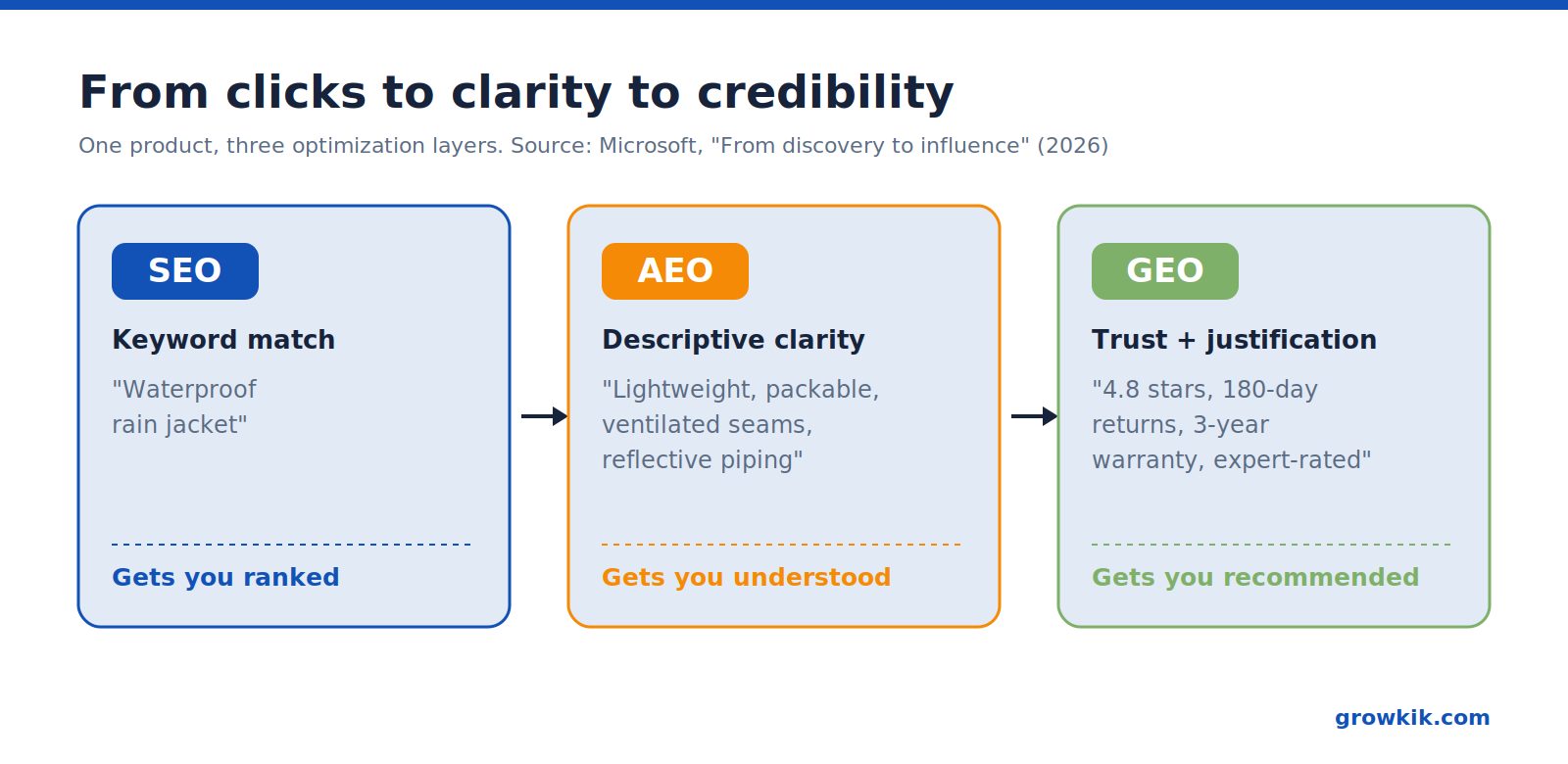
Microsoft summarizes the shift with a single product described three ways. Traditional SEO targets the keyword: waterproof rain jacket. AEO adds descriptive clarity: a lightweight, packable waterproof jacket with ventilated seams and reflective piping. GEO adds justification: rated best by an outdoor magazine, 4.8 stars, 180-day returns, three-year warranty.
AEO drives understanding. GEO drives confidence. The paper is explicit that classic SEO is not dead; it is the foundation, because AI systems run real-time web searches throughout the shopping journey and your pages still need to rank to be retrieved at all.
The three data layers
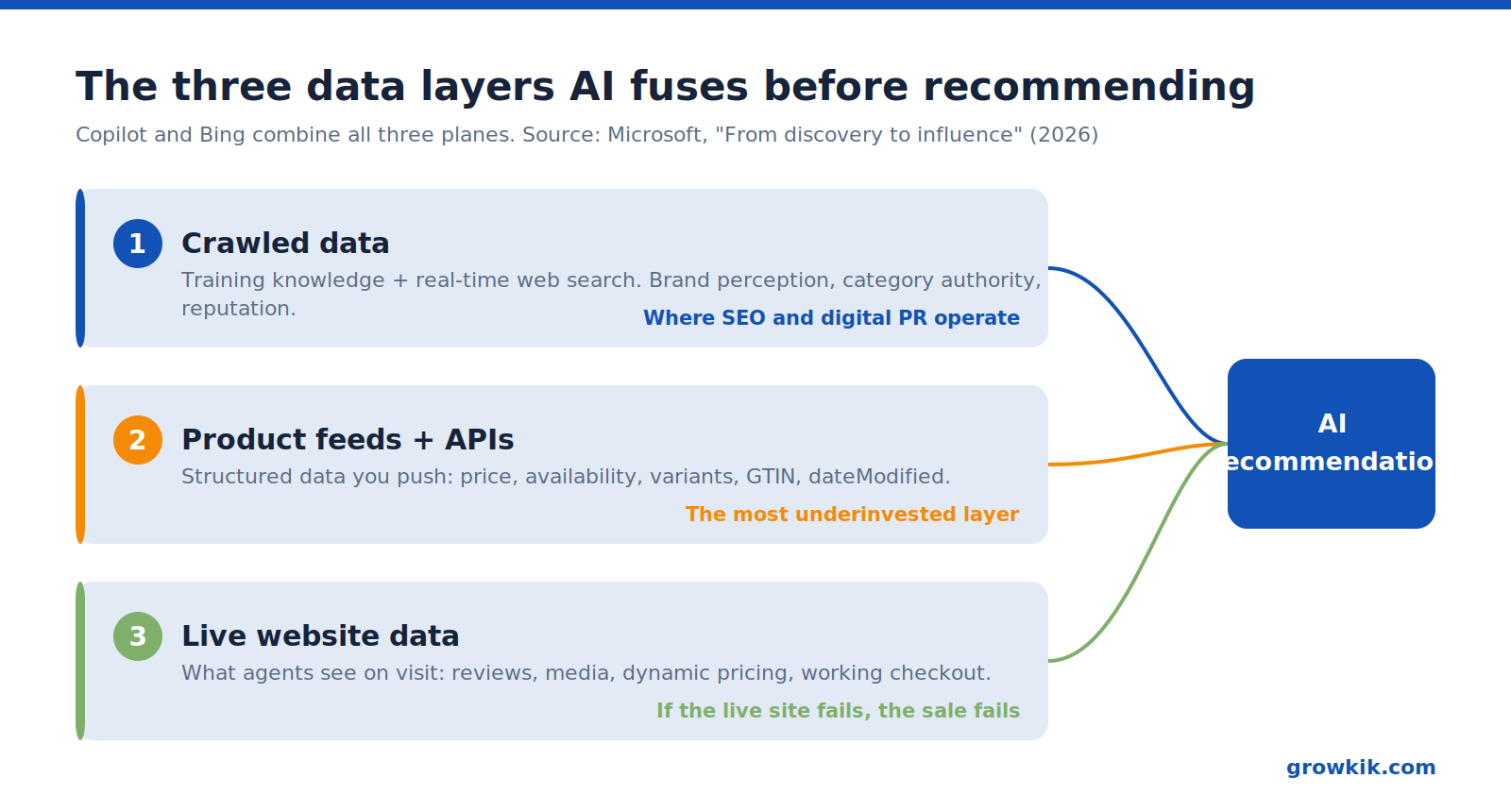
The structural core of the paper is that a brand now exists in three data planes, and AI systems fuse all three before recommending anything.
First, crawled data: what the model learned in training plus what it retrieves from indexed pages in real time. This sets baseline brand perception, category authority, and reputation. This is where traditional SEO and digital PR still operate.
Second, product feeds and APIs: structured data you push to the platform. Price, availability, variants, GTIN, dateModified. This is the layer retailers control most directly and, according to Microsoft, the layer most brands underinvest in.
Third, live website data: what an AI agent sees when it actually visits. Reviews, media, dynamic pricing, promotions, and a checkout that works. Microsoft is blunt about the failure mode: if the live site breaks, the sale fails even when the feed and the crawled data were perfect.
How Copilot actually reasons
The paper walks through a query for a rain jacket under 200 dollars. Copilot combines general knowledge about which brands make quality jackets, category understanding about what a hiking jacket needs, your brand's positioning from crawled data, and then hard numbers from feeds: your model at 179 dollars and in stock, the competitor at 199 dollars and backordered. The product that wins the recommendation wins on the fusion of context, price, and availability, not on any single ranking factor.
This explains a pattern many site owners have already noticed. Pages that rank but never explain, compare, or justify rarely get picked up in AI answers. Ranking gets you retrieved. Justification gets you recommended.
The three action pillars
Microsoft's prescriptions fill the last third of the paper and they are the most actionable part.
Technical foundations. Machine-readable catalogs with dynamic fields such as price, availability, SKU, GTIN, and dateModified. Schema types: Product, Offer, AggregateRating, Review, Brand, ItemList, and FAQ. ItemList markup for category pages, inLanguage and priceCurrency for multi-region operations, and JSON-LD with correct types. One rule stated without hedging: never serve different HTML to bots than to users.
Intent-driven content. Front-load descriptions with who the product is for, what problem it solves, and why it is better. Add use-case framing an assistant can match to a query. Write headings that mirror real questions. Provide Q&A blocks, comparison tables, key-value spec lists, video transcripts, and detailed alt text with ImageObject schema. Microsoft's framing here is worth quoting because it captures the shift: this is content designed for extraction, not just for reading.
Trust signals. Verified reviews marked up with Review and AggregateRating schema, review volume and sentiment surfaced explicitly, links to expert coverage, certifications expressed as factual entities, and consistent brand identity across touchpoints. The paper warns that AI systems penalize exaggerated or unverifiable claims. That claim is not backed by data in the document, but it aligns with how retrieval systems weight corroborated information.
What transfers beyond retail
Growkik's read: about two thirds of this guide applies to any site that wants AI visibility, and one third is Microsoft-ecosystem plumbing.
Transfers directly to consultancies, SaaS, publishers, and local businesses: schema coverage including FAQ and Organization types, intent-front-loaded copy, headings that mirror questions, modular Q&A blocks, comparison content, entity-consistent brand identity, and verifiable trust signals. Also the parity rule: the rendered DOM must contain the same facts users see, which is a real constraint for JavaScript-heavy sites and a reason we insist on server-rendered heads and content.
Microsoft-specific and retail-specific: product feeds through Merchant Center, GTIN-level catalog fields, and agent-completed checkout. If you sell products, feeds are now table stakes on every AI surface; note that ChatGPT shopping runs its own separate feed specification, so covering one platform does not cover the others. If you sell services, your equivalents are structured service pages, pricing clarity, and third-party proof.
What we would ignore: the viral framing. The document does not reveal ChatGPT traffic tactics, it does not say you need dozens of articles at scale, and it says nothing about backlinks. Claims like those got attached to the summary threads by people selling content packages. Vet the source, then act on the source.
Frequently asked questions
Is this an official Microsoft document?
Yes. It is published by Microsoft Advertising and authored by the product team behind Microsoft Shopping and Copilot. It is also a marketing asset for Microsoft Merchant Center, so read its emphasis on feeds with that in mind.
Does this guide explain how to get traffic from ChatGPT?
No. ChatGPT is mentioned only as an example of an AI assistant. The mechanics described are Copilot and Bing. Many principles overlap across assistants, but the document makes no claims about ChatGPT distribution.
Does traditional SEO still matter for AI search?
According to Microsoft, yes, and structurally so. AI systems perform live web searches throughout the user journey, so pages that do not rank do not get retrieved, and pages that do not justify do not get recommended.
What should a non-ecommerce site do first?
Fix schema coverage, restructure key pages so the first paragraph states who the page is for and what problem it solves, add a Q&A block that answers real queries, and make sure server-rendered HTML matches what users see. That sequence covers most of the transferable advice in the guide.
Source: Microsoft Advertising, "From discovery to influence: A guide to AEO and GEO" (PDF).