What SEO is, in plain words
SEO stands for Search Engine Optimization. Strip away the technical name and it means one thing: making sure that when someone types what you sell into Google, your business is one of the first results they see.
Think of Google as the busiest street in the world. Every day, millions of people walk down it looking for a plumber, a lawyer, a software tool, a clinic. Your website is your storefront. SEO is everything you do so that your storefront sits at the start of that street, where everyone walks past it, instead of in a back alley nobody visits.
The key detail: the people searching are already looking for you. Nobody types "emergency plumber near me" out of curiosity. SEO does not interrupt people with advertising. It puts you in front of people at the exact moment they want what you offer. That is why visitors from Google tend to convert into customers at a much higher rate than visitors from social media or display ads.
How Google decides who shows up first
Google is not magic and it is not random. It works like a giant library with three jobs:
- Crawl. Google's software visits your website and reads every page, the same way a person would click through it. If your site is slow, broken, or confusing to navigate, Google may not read all of it.
- Index. Everything it reads gets filed into a massive catalog. If a page is not in the catalog, it can never appear in results, no matter how good it is.
- Rank. When someone searches, Google sorts every relevant page in its catalog and shows the ones it trusts most, first.
That last step, ranking, is where the competition happens. Google decides trust based on hundreds of signals, but almost all of them boil down to three questions:
- Does this page answer what the person searched for? This is about your content: the words on your pages.
- Does the site work well? Speed, mobile experience, and whether Google can read it without problems. This is the technical side.
- Do other trusted sites vouch for it? When reputable websites link to yours, Google reads each link as a recommendation. In SEO these are called backlinks, and they work like word of mouth for the internet.
Good SEO improves all three at once. That is why "just add some keywords" almost never works on its own: keywords address only the first question.
Why being on page 1 matters so much
It is not enough to appear "somewhere" on Google. Position determines almost everything. Look at how clicks distribute across the results:
Out of every 100 people who search, roughly 28 click the first result, 15 click the second, and 11 click the third. By position 5 you are down to about 6 clicks, and page 2 is close to invisible. These numbers vary by search, but the shape of the curve does not: the top spots take almost all the traffic.
This has a hard business consequence. If your competitor ranks 1st and you rank 8th for "accounting software for restaurants", you are not getting a slightly smaller share of customers. You are getting almost none of them, even if your product is better. SEO is the work of closing that gap.
SEO vs paid ads: renting vs building
The most common question we hear: "I already run Google Ads, why would I need SEO?" The honest answer is that they solve different problems.
Paid ads are like renting a billboard. They work immediately, which is their great strength. But the moment you stop paying, you vanish. Your visibility is borrowed, and in competitive markets the rent goes up every year as more advertisers bid on the same searches.
SEO is like building on land you own. It starts slower, but every improvement stacks on the previous one. A page that reaches the top positions can bring in customers every month for years, without a cost per click. The traffic becomes an asset of the business, not an expense line.
The smart play is rarely one or the other. Ads cover you today. SEO reduces how dependent you are on ads tomorrow. Businesses that invest only in ads are running on a treadmill: impressive speed, zero accumulated distance.
What about ChatGPT and AI search?
More and more people skip the list of links entirely and ask an AI assistant instead: ChatGPT, Google's AI Overviews, Gemini, Perplexity, Copilot. A fair question follows: "if people stop clicking results, does SEO still matter?"
It matters more. Those AI tools do not invent their answers out of thin air. They read the web, decide which sites to trust, and cite or recommend the businesses they found there. The work of showing up in AI answers has its own name, GEO (Generative Engine Optimization), and it draws directly from SEO: a site that Google can read, content that clearly answers real questions, and mentions on sites the machines already trust.
Here is what that looks like measured on a real site:
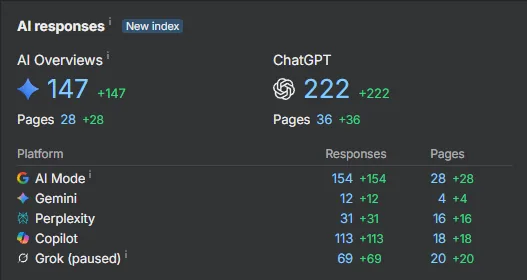
Notice the pattern: the pages getting cited by ChatGPT and AI Overviews are pages that were built and optimized the classic way. The three trust questions from the previous sections are the same ones the AI engines ask. That means the SEO work you invest in now pays twice: once in Google's results, and again every time an AI assistant answers a question in your industry and mentions you instead of your competitor.
What SEO work actually looks like
"SEO" sounds abstract, so here is what a consultant actually does, organized around the three trust questions from earlier:
1. Technical foundation
Making sure Google can read your entire site without obstacles: fixing broken pages, improving speed, making the site work well on phones, and telling Google which pages matter. This is invisible to your customers but decisive for Google. It is the equivalent of making sure your store's door opens and the lights are on.
2. Content that matches real searches
Researching the exact words your customers type, then making sure your site answers those searches better than anyone else. Often the problem is not that a business has bad content, but that its pages talk about "solutions" and "services" while customers search for "how much does it cost to..." in their own words, and in their own language. For companies selling across countries and languages, this is where international SEO makes or breaks results.
3. Authority and reputation
Earning mentions and links from sites Google already trusts: industry publications, news outlets, respected blogs. This is the slowest part and the one with the most scams around it, which is why quality matters far more than quantity. A handful of links from genuinely reputable sites moves rankings more than hundreds of cheap ones, and cheap ones can actively hurt you.
A serious SEO engagement also includes measurement: you should always know which searches bring you traffic, which pages convert, and what changed month over month. If a provider cannot show you that, be skeptical.
Signs your business needs SEO
You likely need SEO if any of these sound familiar:
- You search for your own product or service on Google and you are not there. Your competitors are getting those customers right now.
- Almost all your website visits come from ads or social media. If the ad budget stops, so does the business. That is a fragile position.
- People only find you by your brand name. That means Google shows you to people who already know you, and hides you from everyone still deciding.
- You sell in more than one country or language and traffic only comes from one. Usually a fixable technical and content problem, not a demand problem.
- Your customer acquisition cost keeps rising. Organic traffic is the most reliable way to bring it back down over time.
What to realistically expect
Honesty matters here, because SEO has a credibility problem created by people who overpromise. Realistic expectations:
- First 1 to 2 months: diagnosis and foundation. Technical fixes, content plan, measurement in place. Little visible movement yet, and that is normal.
- Months 2 to 4: early signals. More pages indexed, rankings climbing for less competitive searches, first new organic inquiries.
- Months 4 to 8 and beyond: compounding. Rankings for valuable searches, growing traffic that does not depend on ad spend, and clear before-and-after numbers.
If someone guarantees you position 1 in weeks, walk away. Google itself states publicly that nobody can guarantee rankings. What a good consultant can guarantee is a transparent process, honest reporting, and work that compounds instead of putting your domain at risk.
Frequently asked questions
How long does SEO take to show results?
For most sites, the first measurable movement appears in 2 to 3 months, and meaningful business results in 4 to 8 months. Anyone promising the first page in 2 weeks is either targeting terms nobody searches for or using tactics that can get your site penalized.
Is SEO a one-time job or an ongoing effort?
Both. There is one-time foundational work, such as fixing technical issues and structuring your pages, and ongoing work, such as publishing content and earning mentions from other sites. Rankings are competitive: if you stop entirely, competitors who keep investing will eventually pass you.
Can I do SEO myself?
The basics, yes: writing clear page titles, describing your services in the words customers use, and keeping your Google Business Profile updated. The technical and competitive layers, such as diagnosing why Google ignores certain pages or earning links from reputable sites, are where a consultant saves you months of trial and error.
Do I still need SEO if I run paid ads?
Ads and SEO answer different questions. Ads buy you visibility for as long as you pay. SEO builds visibility you own. Most healthy strategies use ads for immediate demand and SEO for the long-term asset, then reduce ad dependence as organic traffic grows.